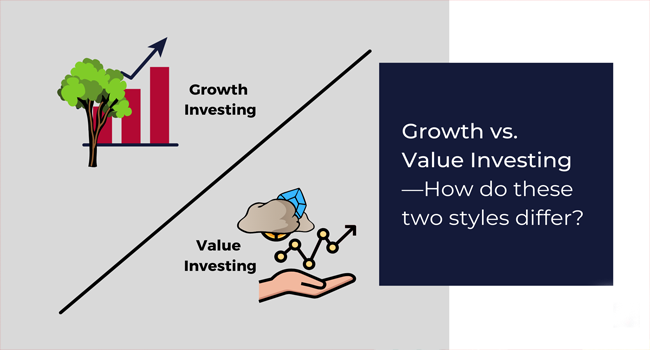
Investing is not merely a game of chance or a random selection of stocks. It’s a calculated enterprise guided by various investment philosophies and strategies. Two fundamental styles that have captured the eye of investors worldwide are “Value Investing” and “Growth Investing.” Both patterns have their merits, adherents, and reviews, but they represent excellent processes to the market. Understanding the nuances among these patterns is essential for traders seeking to navigate the complex terrain of economic markets efficiently.
Defining Value and Growth Investing in Investment
Value Investing
- As popularized by Benjamin Graham and later delicately by Warren Buffett, value investing revolves around purchasing stocks that might be bought and sold at a price under their intrinsic value. Cost buyers search for companies that the market has undervalued, typically due to temporary setbacks, enterprise trends, or different factors inflicting investor pessimism.
- The essential principle underlying price investing is the perception that through the years, the market will understand the true worth of those undervalued stocks central due to their charge appreciation. Value trader’s awareness of metrics, low price-to-earnings (P/E) ratios, low price-to-e-book (P/B) ratios, high dividend yields, and other indicators of monetary power.
Growth Investing
- Growth investing, however, facilitates figuring out businesses with strong potential for future boom. Investors following this style are less involved with the cutting-edge valuation metrics and more interested in the enterprise’s increased possibilities, including sales increase, income increase, market share expansion, and disruptive innovation inside their enterprise.
- Growth buyers are willing to pay premium expenses for shares if they consider the corporation capable of supplying giant growth in the future. They frequently prioritize corporations in swiftly expanding sectors or those poised to exploit rising developments and technology.
Key Differences
Investment Philosophy
- At its center, the primary difference between price and growth investing lies in their underlying philosophies. Value investors prioritize capital upkeep and seek to shop for shares at a reduction in their intrinsic value, aiming to reduce drawback danger. They undertake a conservative technique, emphasizing the importance of the margin of safety and focusing on installed groups with solid coin flows.
- Conversely, increased buyers are more excellent and willing to tackle threats for higher returns. They are interested in groups with robust growth capacity, even if it means paying a premium for their shares. Growth investors frequently put money into early-level companies or industries undergoing fast transformation, banking on future growth to drive returns.
Metrics and Criteria
- The metrics and criteria used to assess ability investments also range extensively between value and increase investing. Value traders depend upon traditional valuation metrics such as P/E ratios, P/B ratios, and dividend yields to discover undervalued stocks. They are trying to find companies with strong economic basics, solid earnings, and a history of consistent dividend bills.
- In comparison Boom investors focus more on non-monetary metrics such as revenue boom prices, earnings growth charges, market proportion expansion, and qualitative factors, just like the energy of a corporation’s management group and its competitive blessings. They are less worried about modern-day valuations and more interested in the corporation’s long-term growth trajectory.
Risk Management
- Risk control is another place where fee and growth investing diverge. Value buyers prioritize drawback safety and focus on minimizing losses through investing in undervalued stocks with a margin of protection. They generally tend to choose corporations with strong coin flows, robust balance sheets, and mounted market positions, which give a cushion throughout market downturns.
- Growth traders, however, are more tolerant of volatility and brief-time period fluctuations in stock expenses. They recognize that investing in excessive-increase agencies inherently contains more hazards. However, they trust that the capability rewards outweigh the risks in the long run. Growth investors are inclined to tolerate quick-time period volatility in pursuit of outsized returns through the years.
Advantages and Disadvantages
Value Investing
Advantages:
Downside Protection: Value investing provides a margin of safety by focusing on undervalued shares, which allows mitigate disadvantage hazards.
Conservative Approach: Value traders prioritize capital protection and invest in hooked-up organizations with solid coin flows and coffee debt levels.
Historical Track Record: Value-making has an extended record of success, with mythical investors like Warren Buffett attaining beautiful returns over the long tea

Disadvantages:
Limited Growth Potential: Value stocks may additionally trade at a reduction for a motive, along with stagnant growth or declining enterprise prospects, limiting upside ability.
Value Traps: Some cost stocks may appear cheap based on traditional metrics but fail to recover due to underlying issues within the company or industry.
Underperformance During Bull Markets: Value shares can also underperform throughout periods of market exuberance while investors desire excessive boom and momentum stocks.
Growth Investing
Advantages:
High Growth Potential: Growth-making offers the capacity for outsized returns via investing in groups with solid increase potentialitpotentialption of Disruptive Technologies: Growth traders can capitalize on rising tendencies and disruptive technology by investing in innovative agencies at an early degree.
Resilience During Bull Markets: Growth stocks tend to outperform during bull markets as investors flock to high-growth corporations with promising future possibilities.
Disadvantages:
High Valuations: Growth stocks often trade at premium valuations, making them prone to sharp corrections if increased expectations aren’t met.
Volatility: Growth stocks are extra liable to volatility and might revel in huge fee swings due to modifications in marketplace sentiment or organization performance.
- Lack of Dividend Income: Many growth businesses reinvest their income lower back into the commercial enterprise rather than paying dividends, which may not suit investors in search of everyday profits.
Market Conditions and Performance
- Market conditions play a sizeable position in determining the relative overall cost performance and increased shares. Historically, price shares have tended to outperform throughout economic downturns or market corrections as investors flock to safer, more shielding investments. In assessment, growth stocks typically outperform in bull markets when investor sentiment is lovely and the chance urge for food is high.
- However, the lines between cost and growth investing have become increasingly blurred in recent years, as technological improvements, changing client choices, and globalization have reshaped industries and disrupted conventional business fashions. Many companies that were once taken into consideration price stocks have embraced innovation and skilled considerable boom, blurring the distinction between the two styles.
Conclusion
In the end, fee and boom investing represent distinct processes of investing, each with its principles, strategies, and danger-praise profiles. While price-making an investment emphasizes buying undervalued shares with a margin of protection, increase-making an investment focuses on figuring out businesses with solid growth potential, even at top-rate valuations. Both styles have their deserves and drawbacks, and successful investors often incorporate factors of both tactics into their funding method. Ultimately, the choice between fee and increase investing depends on man or woman preferences, danger tolerance, and funding targets. By providing information on the variations among these two patterns and their implications for portfolio production, buye